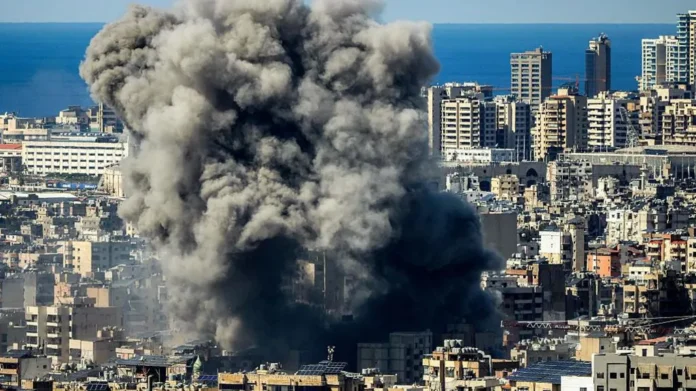


The Israeli military says it has launched a new wave of strikes on targets across Iran and Lebanon as the US-Israeli war with Tehran enters its tenth day, raising fears of a wider regional conflict.
Israeli officials say the strikes are aimed at Iran’s military infrastructure and defence systems, while Iranian authorities accuse Israel of attacking civilian areas and critical energy facilities.
According to the Israel Defense Forces (IDF), more than 3,400 strikes have been carried out since the conflict began on 28 February. Israeli military spokesperson Lt Col Nadav Shoshani said the operations had disabled more than 150 Iranian defence systems and targeted military sites across the country.
The war began with coordinated US-Israeli strikes that Israel said targeted Iran’s leadership and military command structure. Among those killed during the opening attacks was Iran’s former Supreme Leader, Ayatollah Ali Khamenei, who died in Tehran.
Satellite imagery and verified footage have shown widespread damage across Iran. Analysts reviewing images since the start of the conflict have identified damaged aircraft at Tehran’s Mehrabad airport, destruction at naval bases in Konarak and Bandar Abbas, and damage to the nuclear facility at Natanz.
BBC Verify has confirmed visual evidence of more than 110 separate strikes across Iran, including at least 49 in the capital Tehran.
Iran has condemned the attacks, particularly strikes on oil facilities that officials say released hazardous chemicals into the air. The country’s foreign ministry accused Israel of “poisoning civilians” through attacks on industrial sites.
Civilian casualties have also risen sharply. The US-based Human Rights Activists News Agency says at least 1,205 civilians have been killed in Iran since the start of the conflict.
One of the deadliest incidents occurred in Minab in southern Iran, where authorities say 168 people, including children, were killed when a girls’ school was struck during an attack targeting a nearby Islamic Revolutionary Guard Corps base.
Satellite imagery suggests the area was hit multiple times, with visible burn marks and structural damage surrounding the school.
Experts analysing footage of the strike told BBC Verify that the weapon used appeared to be a US-made Tomahawk cruise missile, although neither Israel nor Iran is known to possess the weapon.
Meanwhile, the conflict is increasingly spreading beyond Iran’s borders. Several Gulf countries reported Iranian missile and drone attacks over the weekend.
The United Arab Emirates said its air defence systems intercepted 17 ballistic missiles and six drones overnight on Monday, following earlier interceptions of dozens more projectiles in recent days.
Bahrain reported that a drone attack injured 32 civilians and triggered a fire at the country’s largest oil refinery. Kuwait also said it had contained a major fire in a government office building after an apparent attack.
Missile launches were also reported targeting Qatar, Saudi Arabia, Oman and Iraq.
The widening conflict is disrupting shipping through the Strait of Hormuz, a vital global energy route through which about 20% of the world’s oil and gas supply passes.
Iran has warned it could target vessels in the area, prompting shipping companies to reroute vessels and raising concerns about global energy supplies.
The war has also extended beyond the Middle East. A US submarine reportedly sank an Iranian warship off the coast of Sri Lanka, killing 87 sailors, while Azerbaijan accused Iran of launching drones into its territory.
With missile attacks spreading and regional tensions escalating, analysts warn that the conflict risks drawing in more countries and destabilising a critical region for global energy and trade.