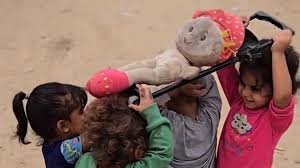


A video published by a Palestinian content creator has drawn global attention after capturing a group of children in Gaza reenacting a funeral scene while playing in a displacement camp.
The footage, widely circulated on social media, shows several children carefully carrying a doll on a makeshift stretcher, mimicking the rituals they have witnessed amid ongoing conflict.
The scene unfolds in a temporary camp where families displaced by months of violence have sought refuge. Surrounded by tents and sparse belongings, the children appear focused and solemn as they participate in the act.
Some walk alongside the stretcher, while others watch quietly, reflecting a striking imitation of real-life events that have become tragically familiar in their environment.
Observers and humanitarian organizations say the video underscores the profound psychological toll that prolonged conflict has on children. Exposure to repeated scenes of loss, funerals, and destruction has increasingly shaped how young people in Gaza interpret the world around them.
In the absence of normalcy, playtime—often a space for imagination and joy—has instead become a reflection of lived trauma.
Child psychologists note that such behavior can be a coping mechanism. By reenacting distressing events, children may be attempting to process fear and grief in a way they can understand.
However, experts warn that continuous exposure to violence without adequate emotional support can lead to long-term mental health challenges, including anxiety, depression, and post-traumatic stress.
The humanitarian situation in Gaza remains dire, with thousands of families displaced and limited access to basic necessities such as food, water, and medical care. For children, the disruption extends beyond physical needs, affecting education, stability, and emotional well-being.
Schools have been destroyed or repurposed as shelters, leaving many without access to structured learning or safe spaces.
Aid agencies have repeatedly called for increased support for mental health services in conflict zones, emphasizing the need for child-focused interventions.
Programs that provide safe recreational activities, counseling, and community support are seen as essential in helping children recover a sense of normalcy.
The video has sparked widespread reactions online, with many expressing heartbreak and concern over the normalization of such experiences for children. Others have pointed to it as a stark reminder of the human cost of conflict, particularly for the most vulnerable populations.
While the children in the video may not fully grasp the broader political and military dynamics at play, their actions reveal a deeper truth about life in war zones. For them, the boundaries between play and reality have blurred, shaped by an environment where loss is a constant presence.
As the conflict continues, the long-term impact on Gaza’s younger generation remains a growing concern. The viral footage serves not only as a poignant moment but also as a call to address the urgent humanitarian and psychological needs of children living through war.