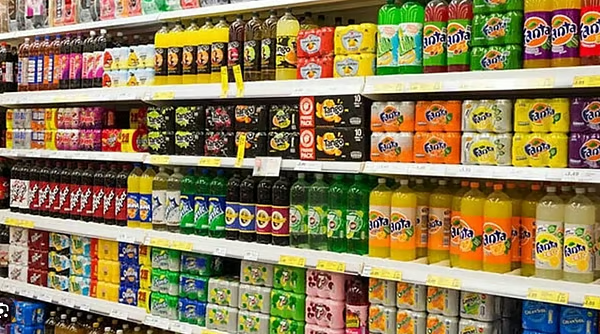


The United Arab Emirates (UAE) is set to introduce a landmark change to its excise tax policy on sweetened beverages, with a focus on sugar content rather than product category. The Ministry of Finance announced on Monday that the new regulations will come into effect on January 1, 2026, as part of wider GCC efforts to adopt a tiered volumetric taxation model.
Under the updated policy, sweetened beverages will no longer face a blanket 50 per cent excise tax. Instead, taxation will be structured around the amount of sugar or sweetener present in each product. Officials say this tiered approach is intended to create a more balanced and competitive tax environment, while also encouraging manufacturers and consumers alike to shift towards healthier choices.
The ministry explained that the proposed legislative amendments have been designed to provide a comprehensive legal and regulatory framework for implementation at the national level. The changes will allow for clarity in how the excise is calculated and ensure consistency with international standards being adopted across Gulf Cooperation Council (GCC) member states.
Significantly, the amendments will also include transitional mechanisms for businesses. Companies that have imported or produced sweetened beverages subject to the 50 per cent excise tax before the new law takes effect — and whose tax liability decreases under the revised model — will be able to deduct part of the previously paid tax, provided the goods have not yet been sold.
“This update represents a step towards fairness and competitiveness in our taxation system,” the Ministry of Finance said in a statement. “It reflects our commitment to adopting international best practices while also supporting national health objectives by reducing sugar consumption.”
The policy shift is consistent with global public health trends, where governments are increasingly using fiscal tools to address high sugar intake, linked to conditions such as diabetes, obesity, and cardiovascular disease. The UAE, like other GCC nations, has been actively working on strategies to promote healthier lifestyles and reduce the burden of non-communicable diseases.
Experts believe the tiered taxation model could incentivise beverage manufacturers to reformulate their products with lower sugar levels, as seen in other countries that have adopted similar measures. This, in turn, may drive innovation in the industry while helping consumers make more health-conscious decisions.
For businesses, the clear guidelines and transitional provisions are designed to ease the implementation process, reducing potential disruptions in the market. Industry stakeholders, including retailers and distributors, are expected to adjust pricing strategies and product portfolios in response to the new system.
The announcement reinforces the UAE’s broader approach to fiscal policy — balancing competitiveness with sustainability and health considerations. By aligning with GCC-wide tax reforms, the UAE is positioning itself as a leader in regulatory modernization across the region.
The Ministry of Finance has assured stakeholders that it will provide further detailed guidance in the lead-up to 2026, ensuring businesses and consumers are well-informed of the changes.