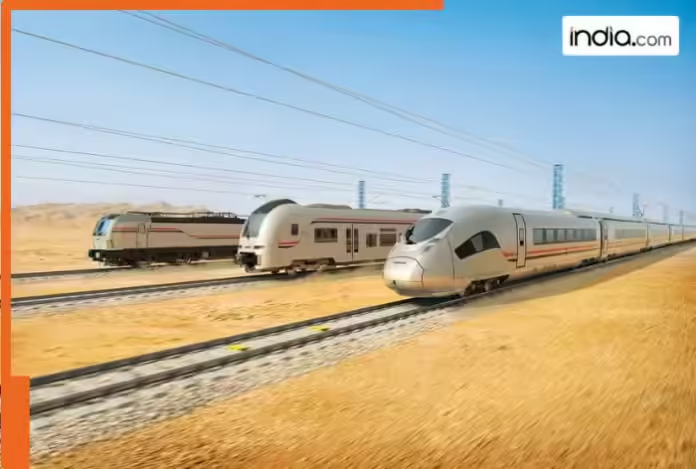


Saudi Arabia and Qatar on Monday signed a historic agreement to build a high-speed railway line linking the two Gulf nations, marking a major milestone in regional transport and economic integration.
The deal was announced following high-level talks in Riyadh between Saudi Crown Prince Mohammed bin Salman and Qatar’s Emir Sheikh Tamim bin Hamad Al-Thani.
The agreement was reached during meetings of the Saudi-Qatar Coordination Council, underlining the growing momentum in bilateral relations. Officials described the project as the first rail link of its kind between the two countries and a symbol of deepening cooperation in infrastructure, trade, and development.
Once completed, the railway will cut travel time between Riyadh and Doha to approximately two hours. This dramatic reduction is expected to transform movement between the two capitals, offering a faster, more efficient alternative to air and road travel for millions of passengers each year.
The total rail route will span around 785 kilometres, with trains capable of reaching speeds of up to 300 kilometres per hour. The line will connect King Salman International Airport in Riyadh with Hamad International Airport in Doha, ensuring seamless integration with major aviation hubs.
Several important cities will be served along the route, including Hofuf and Dammam in Saudi Arabia. These stops are expected to stimulate local economies, enhance domestic mobility, and create new opportunities for business, tourism, and urban development in eastern Saudi Arabia.
Officials from both countries stated that the project is expected to be completed within six years. Planning, design, and construction phases will be carried out using advanced railway technologies that meet international safety and efficiency standards.
According to projections shared during the announcement, the high-speed rail service will be able to accommodate more than 10 million passengers annually once operations begin. This capacity reflects rising demand for fast and reliable transport across the Gulf region.
Beyond passenger travel, the railway is expected to deliver significant economic gains. Both Saudi Arabia and Qatar are projected to benefit by approximately $30.6 billion through increased trade, tourism, productivity, and infrastructure-driven growth over the project’s lifetime.
Employment generation is another key benefit. Around 30,000 jobs are expected to be created during the construction and operational phases, spanning engineering, logistics, maintenance, and service-related sectors across both countries.
Leaders from Riyadh and Doha emphasised that the project aligns closely with their long-term development visions. For Saudi Arabia, it supports Vision 2030 goals focused on diversification, connectivity, and sustainable infrastructure. For Qatar, it complements national strategies aimed at innovation and economic resilience.
Environmental considerations also feature prominently in the project. By encouraging rail travel instead of car or short-haul flights, the line is expected to reduce carbon emissions and promote cleaner transportation methods, supporting broader sustainability and climate objectives.
The agreement was formally signed at Al-Yamama Palace in Riyadh by Saudi Arabia’s Minister of Transport and Logistics Saleh Al-Jasser and Qatar’s Minister of Transport Sheikh Mohammed bin Abdullah bin Mohammed Al-Thani. The signing ceremony highlighted the political commitment behind the ambitious undertaking.
Both leaders also co-chaired the eighth session of the Qatar-Saudi Coordination Council, during which a range of cooperation frameworks were reviewed. The railway agreement stood out as one of the most significant outcomes of the session.
Regional analysts view the project as a potential cornerstone for wider Gulf railway integration. Once completed, it could serve as a key link within a future GCC-wide rail network, strengthening economic ties and people-to-people connections across the region.
As construction plans move forward, the Saudi-Qatar high-speed railway is being widely seen as more than a transport project. It represents a strategic investment in regional unity, economic progress, and sustainable development for the Gulf’s future.
This article was created using automation technology and was thoroughly edited and fact-checked by one of our editorial staff members