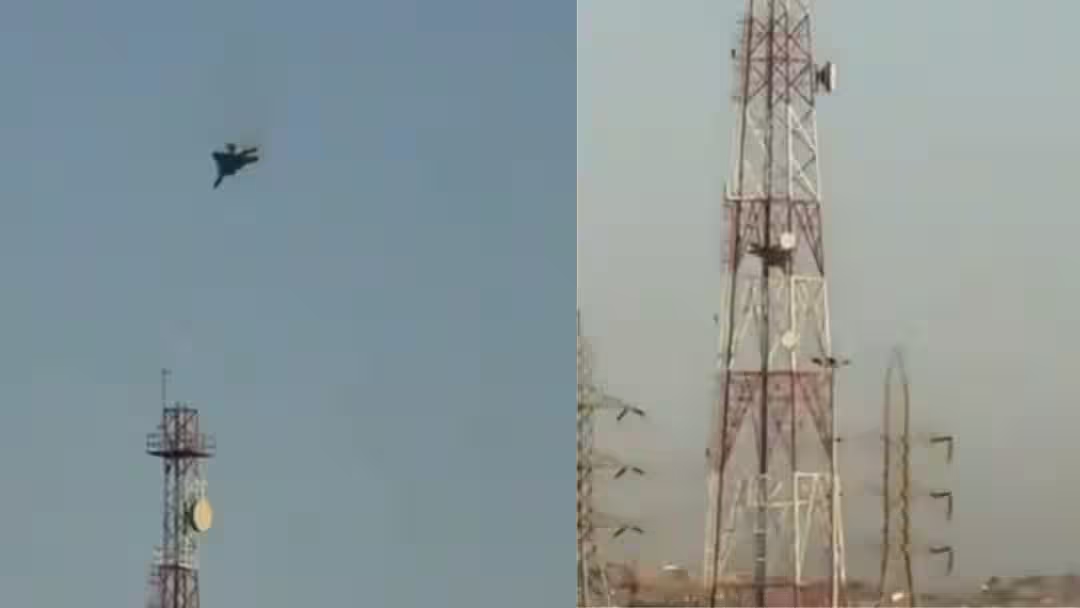


Iranian authorities on Monday claimed that a United States F-15 fighter aircraft had crashed over Kuwait, alleging the pilot ejected moments before impact.
Officials speaking through state-linked channels in Tehran said the jet came down during heightened military activity across the Gulf, though they did not provide coordinates, timing, or supporting evidence.
Video clips widely shared on social media appear to show a parachute descending slowly over a desert landscape, followed by images of a man on the ground surrounded by unidentified individuals. Iranian broadcasters said the footage depicted the American pilot shortly after ejecting.
However, the visuals have not been independently verified, and there has been no confirmation from either Kuwait or Washington that an aircraft was lost.
The United States military has so far declined to comment directly on the alleged crash. A spokesperson for the Pentagon said only that “no operational losses have been reported,” without elaborating further.
The incident claim comes amid rapidly worsening hostilities between Iran and American-aligned forces across West Asia. In recent days, missile and drone exchanges have extended from Iranian territory toward targets around the Gulf and beyond.
Analysts say the timing of the allegation is significant. Competing narratives, including unverified battlefield claims, have increasingly become part of the information war accompanying the military confrontation.
Military experts note that the F-15, produced by Boeing, remains one of the backbone air-superiority fighters of the US Air Force. The aircraft is capable of operating from bases across the region, including facilities used jointly with Gulf allies.
If confirmed, the loss of such an aircraft would mark a rare and politically sensitive development. American combat aircraft accidents or shoot-downs in contested airspace are closely scrutinized and often rapidly addressed by the US Department of Defense.
Regional aviation tracking platforms and open-source intelligence groups also said they had not observed radar data or emergency signals consistent with a crash over Kuwait. Some specialists suggested the video could be old or unrelated footage recirculated amid the crisis.
Iranian outlets, meanwhile, presented the episode as evidence of what they described as growing vulnerability among US forces operating near Iranian airspace. Several commentaries linked the alleged incident to recent military movements by the Islamic Revolutionary Guard Corps.
Kuwaiti authorities have yet to issue a public statement. Residents contacted by local reporters said they had not seen debris or emergency response activity consistent with an aircraft accident.
The absence of on-the-ground confirmation has fueled skepticism among international observers. Defense analysts cautioned that unverified wartime claims often circulate quickly online, sometimes aimed at shaping public perception rather than reporting confirmed events.
Still, the report highlights the fragile security situation across the Gulf. Commercial air traffic, military patrols, and regional defense systems are operating in close proximity as tensions escalate.
Diplomatic sources said governments are working quietly to prevent misunderstandings that could trigger broader escalation. “In an environment like this, even a rumor can spark consequences,” one Western official said.
For now, the alleged crash remains unproven. Until physical evidence or official acknowledgment emerges, the claim is likely to remain part of the growing fog of information surrounding the unfolding crisis.
As exchanges continue across the region, observers say clarity may depend on satellite imagery, independent investigations, or formal statements from the parties involved. Until then, the story underscores how quickly unverified reports can spread during conflict.