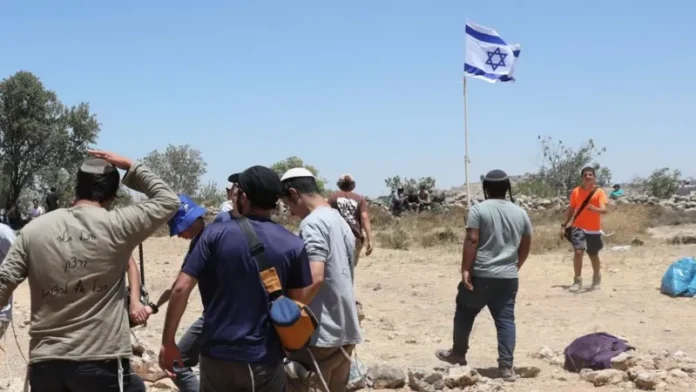


WEST BANK, PALESTINIAN TERRITORIES – Escalating settler attacks and rapid outpost expansion deepen tensions in areas under Palestinian Authority control, raising international concern
A Palestinian man has been killed and several others seriously injured following a series of violent incidents involving Israeli settlers in the occupied West Bank, marking a sharp escalation in tensions across the region.
The latest fatality, identified as Mohammad al-Malhi, was reportedly shot in the head near the city of Bethlehem. According to his family, the incident occurred after settlers established an unauthorised outpost on land belonging to Palestinian residents.
Relatives of the victim claim that Israeli soldiers had earlier dismantled the outpost. However, they allege that settlers returned shortly after the army withdrew and rebuilt the structures, leading to a confrontation that ended in Malhi’s death.
The Israel Defense Forces confirmed that a clash had taken place between settlers and Palestinians in the area. In a statement, the military said that an Israeli civilian opened fire during the confrontation, resulting in one death and injuries to three others.
This incident marks the seventh Palestinian fatality linked to settler violence since the escalation of regional tensions following the outbreak of the Israel–Iran conflict escalation 2026 at the end of February.
Local residents report that violence has intensified in parallel with the rapid establishment of new settler outposts. These small clusters of housing, often erected without formal government approval, are increasingly appearing in areas designated under Palestinian Authority control.
Such developments are considered particularly provocative, as Israeli law technically restricts Israeli citizens from entering certain zones administered by the Palestinian Authority. Despite this, multiple outposts have reportedly been constructed in these areas in recent days.
In the northern West Bank, another violent episode has drawn attention. In the village of Tayasir, near Tubas, a 75-year-old Palestinian man was severely beaten during a settler raid.
Video footage circulating on social media shows the elderly man bruised and bloodied inside his home. Residents claim that settlers stormed the village and opened fire on young men who attempted to confront them, further escalating the situation.
Eyewitnesses describe a pattern of coordinated incursions by settlers into Palestinian communities, often occurring after new outposts are established nearby. These raids frequently involve property damage, physical assaults, and, in some cases, the use of live ammunition.
The surge in violence reflects a broader trend that has been unfolding since the outbreak of the 2023 Hamas-led attack on Israel and the subsequent war in Gaza. During this period, both settler activity and military operations have intensified across the West Bank.
According to international observers, last year saw a record number of settlement expansions and planning approvals since monitoring began by the United Nations. The pace of development has raised alarm among diplomats and human rights groups.
While Israeli government-backed settlements are widely regarded as illegal under international law, the status of outposts adds another layer of complexity. These structures are typically built without official authorisation but are sometimes later retroactively legalised.
Israeli media reports indicate that the country’s security cabinet recently approved the retroactive legalisation of approximately 30 such outposts across the West Bank. The move has been criticised by Palestinian officials and international actors as further entrenching occupation.
The expansion of settlements and outposts continues to reshape the landscape of the West Bank, where approximately 700,000 Israeli settlers now live among an estimated 3.3 million Palestinians.
This demographic reality stems from the aftermath of the 1967 Middle East war, during which Israel occupied the West Bank and East Jerusalem—territories Palestinians seek for a future independent state alongside Gaza.
Human rights organisations warn that the increasing frequency and severity of settler attacks are contributing to a climate of fear and instability. Palestinian communities in affected areas report feeling increasingly vulnerable, particularly in rural regions where security presence is limited.
Many residents argue that the lack of accountability for settler violence has emboldened further attacks. They point to what they describe as inconsistent enforcement by Israeli authorities, especially in cases involving unauthorised outposts.
Israeli officials, however, maintain that security forces intervene when necessary and have, in some cases, dismantled illegal outposts. Nonetheless, critics argue that such actions are often temporary and fail to address the root causes of the conflict.
The international community continues to call for restraint and renewed dialogue, though prospects for meaningful negotiations remain uncertain amid ongoing regional tensions and political divisions.
As violence escalates, the situation in the West Bank underscores the fragility of the status quo. With each new incident, fears grow that the cycle of confrontation may deepen, further complicating efforts to achieve a lasting resolution.
For families like that of Mohammad al-Malhi, the consequences are immediate and devastating. His death serves as a stark reminder of the human toll of a conflict that shows little sign of abating.
This article was created using automation technology and was thoroughly edited and fact-checked by one of our editorial staff members