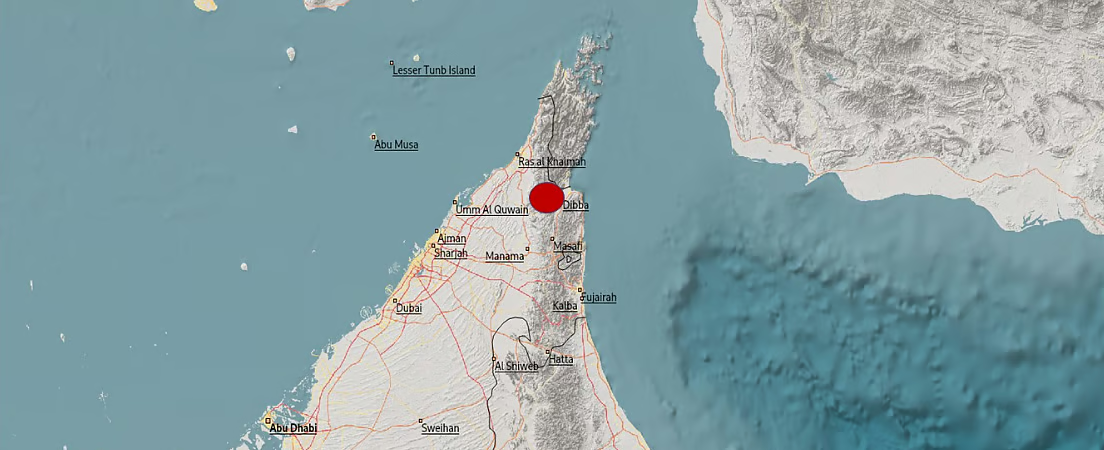


A mild earthquake measuring 2.9 on the Richter scale struck south of Musandam in the early hours of Sunday, December 28, according to the National Centre of Meteorology (NCM). The quake was recorded at 4.44am UAE time by the NCM’s National Seismic Network, which continuously monitors seismic activity across the region.
Authorities said the earthquake occurred at a shallow depth of approximately 5 kilometres, a factor that can make tremors more noticeable even when magnitudes remain low. Residents in parts of the UAE reported feeling slight tremors, particularly in the Northern Emirates, though the NCM confirmed the event had no impact on the country.
“There was no damage reported and no cause for concern,” the NCM said, adding that such minor seismic events are monitored closely as part of routine geological surveillance. Musandam lies to the south of the strategic Strait of Hormuz and is primarily governed by Oman as the Musandam Governorate.
However, certain areas fall under UAE administration, including Ras Al Khaimah and parts of Dibba, making seismic events in the region relevant to both countries. The peninsula’s geographical position places it near tectonic boundaries that can occasionally generate earthquakes felt across the wider Gulf region.
Neighbouring countries such as Iran, Iraq and Oman experience frequent seismic activity, and tremors from stronger earthquakes are sometimes felt in the UAE. On November 4, a magnitude 4.6 earthquake struck south of Musandam, with residents in several Emirates reporting noticeable shaking.
Earlier this month, on December 17, an earthquake measuring 4.3 hit a province in Saudi Arabia during the early morning hours. Despite its strength, the Saudi quake had no impact on the UAE, according to regional monitoring agencies.
On December 1, Bahrain also recorded a 3.3-magnitude earthquake in the early hours, which likewise caused no effects in the Emirates. Meanwhile, a stronger earthquake of magnitude 5.0 struck Iraq on November 22 at a depth of 30 kilometres, but was not felt in the UAE.
Back in August, a 2.2-magnitude earthquake was recorded in Oman’s Madha region, a small Omani exclave surrounded by the UAE. Madha lies within Fujairah and is governed by Oman’s Musandam Governorate, despite being geographically isolated from the rest of the country.
Although the UAE is not located on a major fault line, experts say it can occasionally experience minor tremors due to regional tectonic activity. The country lies relatively close to the Zagros mountain range, one of the most seismically active regions in the world.
The Zagros range stretches across Iran and Iraq and is responsible for frequent earthquakes, some of which are powerful. In a previous interview with Khaleej Times, seismologist Mohamed Alhassani, acting head of the Seismic Monitoring Section at the NCM, explained the phenomenon.
“These events, though often centred hundreds of kilometres away, can produce tremors that may be felt in parts of the UAE, especially in the Northern Emirates,” he said. Alhassani noted that shallow or moderate earthquakes in neighbouring regions are more likely to be felt, even if they pose no real danger.
On August 22, a magnitude 3.3 earthquake struck the Safad area in Fujairah, briefly drawing attention to the country’s seismic monitoring capabilities. The NCM has repeatedly reassured residents that the UAE’s infrastructure is designed to withstand minor tremors.
Authorities continue to urge the public to rely on official sources for accurate information and to avoid spreading rumours during seismic events.
While earthquakes in the region remain relatively infrequent and mild, monitoring agencies stress the importance of preparedness and awareness. For now, Sunday’s Musandam earthquake serves as another reminder of the UAE’s proximity to active seismic zones, even as daily life continues uninterrupted.