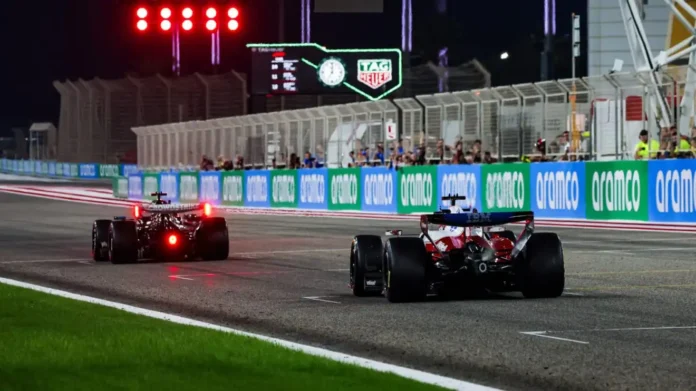


Bahrain delivered an early glimpse into the pecking order for the new Formula 1 season, with Mercedes-AMG Petronas Formula One Team making visible gains off the line but still trailing the explosive starts of Scuderia Ferrari, according to rookie driver Kimi Antonelli.
Across the final days of pre-season running at the desert circuit, launch performance became one of the most closely watched indicators of competitiveness. While power unit debates dominated headlines, simple traction and acceleration repeatedly shaped track position into Turn 1.
Mercedes focused heavily on refining the W17’s clutch bite point, throttle mapping and anti-wheelspin systems. Engineers conducted multiple practice starts at the end of sessions, attempting to iron out inconsistencies that hurt the team during parts of last year.
Antonelli said the difference was noticeable. The team’s starts looked cleaner and more controlled, with less bogging down or sudden spikes in wheelspin that can cost metres in the first seconds of acceleration. Yet even with those gains, Ferrari remained the benchmark.
The Italian squad’s launches repeatedly caught the paddock’s attention, with their car snapping forward decisively the moment the lights went out. Observers noted how consistently the red machines gained ground in short sprints to the first braking zone.
The contrast was particularly evident during practice grids on Thursday and Friday evenings. Under new measures introduced by the Fédération Internationale de l’Automobile, drivers received a pre-warning for the start procedure.
The system aimed to avoid chaos and improve safety while still allowing realistic launch simulations during testing. Even with that structure, Ferrari’s getaway speed stood out.
According to Mercedes driver George Russell, the Ferrari repeatedly surged ahead despite starting from less favourable positions. On two occasions, the scarlet cars blasted past before the first corner despite beginning several rows back.
One of those runs saw Russell start from pole, yet still lose ground almost instantly. The rapid acceleration suggested superior traction or possibly differences in turbo response. Speculation around Ferrari’s setup has grown.
Some rivals believe the team may be running a smaller turbocharger configuration, helping reduce lag and deliver quicker torque at lower speeds. While unconfirmed, the theory would explain the immediate punch that appears to define the Ferrari’s launch.
For Antonelli, the lesson was clear: Mercedes has progressed, but there is still work to do. He stressed that while the W17 now reacts more predictably, Ferrari’s starts remain “blistering.”
That final edge could prove decisive once racing begins, where overtaking opportunities are limited and track position is everything.
Testing data also showed Mercedes improving consistency rather than outright explosiveness. The team’s starts rarely faltered, but they did not produce the same aggressive jump seen from Ferrari’s cars.
Consistency can still pay dividends over a race distance, especially when tyre management and strategy come into play. However, losing places at the lights often forces drivers into turbulent air and compromises their opening stints. Ferrari, meanwhile, looks confident.
Both Charles Leclerc and Lewis Hamilton, now in red for the upcoming season, completed several eye-catching launches that drew attention from rival garages and pit walls.
The pair repeatedly gained positions within metres, reinforcing the perception that Ferrari has nailed one of the most fundamental aspects of racecraft.
Beyond starts, broader technical debates continued to swirl around the paddock, including discussions over compression ratios and measurement methods.
Those issues could evolve later in the year, but for now, the spotlight remains on pure mechanical performance. As testing concluded in Bahrain, the picture became clearer.
Mercedes has narrowed the gap and solved some of last year’s weaknesses, yet Ferrari’s edge off the line remains the reference point.
With margins in modern Formula 1 measured in hundredths of a second, those first few metres may shape the season’s early battles. When the lights go out for real, the fight to Turn 1 could already tell the story.