

Nearly a week after assuming Iran’s highest political and religious office, Mojtaba Khamenei has yet to appear publicly, fueling speculation about his health, whereabouts and the balance of power inside the Islamic Republic.
Iranians received their first indication of the new leader’s views on Thursday when a lengthy statement attributed to him was read on state television. However, the statement did little to ease questions surrounding his continued absence.
Friday marked both his first weekly prayer day as supreme leader and Quds Day, an occasion when Iran’s leadership traditionally addresses the public. Yet Khamenei did not appear.
According to a source familiar with the situation, Khamenei sustained injuries during the first wave of airstrikes carried out by the United States and Israel nearly two weeks ago. The attacks reportedly killed his father, Ali Khamenei, along with several senior Iranian military commanders.
The source said the new leader suffered a fractured foot, a bruised eye and minor facial lacerations. Officials in Iran have not publicly confirmed the details.
Meanwhile, Masoud Pezeshkian’s son, who serves as a government adviser, stated on social media that Mojtaba Khamenei was injured but safe and recovering.
Speculation about his condition intensified after Pete Hegseth claimed Khamenei may be “likely disfigured,” though he provided no supporting evidence.
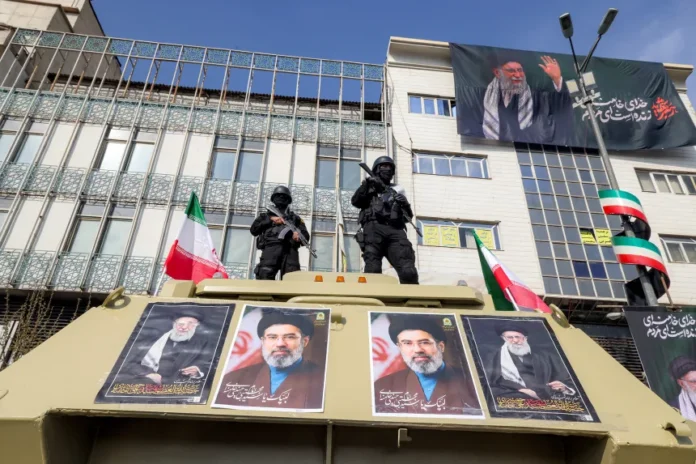
Despite the uncertainty, supporters of the Iranian government have taken to the streets in large demonstrations, pledging loyalty to the new leader during the final days of Ramadan.
At the same time, critics of the regime have mocked Khamenei’s absence online. Edited images portraying him as a cardboard cutout occupying the supreme leader’s seat have circulated widely on social media.
Iranian state media outlets have even distributed AI-generated videos showing Khamenei delivering speeches or appearing alongside his late father—events that never actually occurred. The unusual tactic has led some critics to jokingly label him “the AI supreme leader.”
For decades, Mojtaba Khamenei remained largely out of public view while operating within the political networks surrounding his father’s leadership. His sudden rise to power during a period of conflict has intensified scrutiny of Iran’s political structure.
Analysts say that the country’s powerful institutions may be far more important than the individual occupying the top post.
In particular, the Islamic Revolutionary Guard Corps is believed to be playing a central role in shaping Iran’s wartime strategy.
Political analysts argue that Khamenei’s appointment may primarily provide legitimacy for the existing military and security leadership to continue directing operations.
Historian Arash Azizi says symbolic narratives rooted in Shiite history could also strengthen the regime’s messaging.
“The killing of his father and his own injuries may be framed in ways similar to martyrdom stories tied to the Battle of Karbala,” Azizi said.
For now, many loyalists appear unconcerned about the leader’s absence, viewing secrecy as necessary during wartime.
However, experts warn that the situation may change once the conflict subsides.
Sanam Vakil, director of the Middle East and North Africa program at Chatham House, says Iran’s political elite will eventually require clear signs that the new leader can exercise authority.
Until then, the location of Iran’s supreme leader remains undisclosed—leaving unanswered questions about who truly governs the country during one of its most volatile moments in decades.