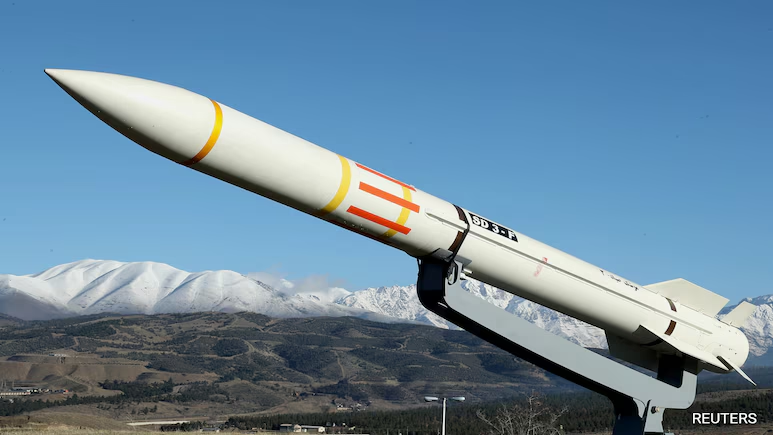


Former Joseph Votel, who once led United States Central Command, has stated that the United States and Israel have succeeded in significantly reducing Iran’s ballistic missile capabilities amid the ongoing conflict in the region.
Speaking in a recent defense analysis, Votel explained that coordinated military efforts, including precision strikes and intelligence-led operations, have “taken out a majority” of Iran’s missile infrastructure.
These developments mark a critical shift in the balance of power, particularly as ballistic missiles have long been a cornerstone of Iran’s deterrence strategy.
According to Votel, Iran’s missile program has historically provided the country with a means to project power across the Middle East without relying heavily on conventional air superiority.
However, sustained operations targeting launch sites, storage facilities, and logistical networks appear to have degraded this advantage.
Despite the losses, Votel cautioned that Iran is far from militarily incapacitated. “They still retain capability,” he noted, emphasizing that remnants of the missile arsenal, along with other military assets, could continue to pose a threat to regional stability.
Analysts agree that even a reduced missile force can be strategically significant, particularly if deployed selectively.
The developments come amid escalating tensions involving multiple actors in the region. While the United States and Israel have not publicly detailed the full scope of their operations, defense experts suggest that advanced surveillance systems and cyber capabilities may have played a role alongside traditional military strikes.
Iran, for its part, has not fully disclosed the extent of the damage to its missile program. Officials in Tehran have previously maintained that their defense capabilities remain intact and have warned against further escalation.
The lack of transparent information has made independent verification difficult, leaving analysts to rely on satellite imagery and intelligence assessments.
The degradation of Iran’s missile capabilities could have immediate tactical implications, potentially limiting its ability to conduct large-scale retaliatory strikes.
However, experts warn that it may also push Tehran to adopt alternative strategies, including asymmetric warfare or the use of proxy groups across the region.
Votel highlighted that the situation remains fluid, with the potential for rapid changes depending on political decisions and military developments. “This is not the end of their capability,” he said, pointing to Iran’s history of resilience and adaptation under pressure.
The broader implications of these developments extend beyond the battlefield. Regional allies and adversaries alike are closely monitoring the situation, as shifts in Iran’s military strength could influence diplomatic negotiations, security alliances, and future conflict scenarios.
As the conflict continues, the focus will likely remain on whether Iran can rebuild its missile infrastructure and how the United States and Israel respond to any such efforts. For now, Votel’s assessment underscores a significant, though not निर्णtive, turning point in the ongoing confrontation.