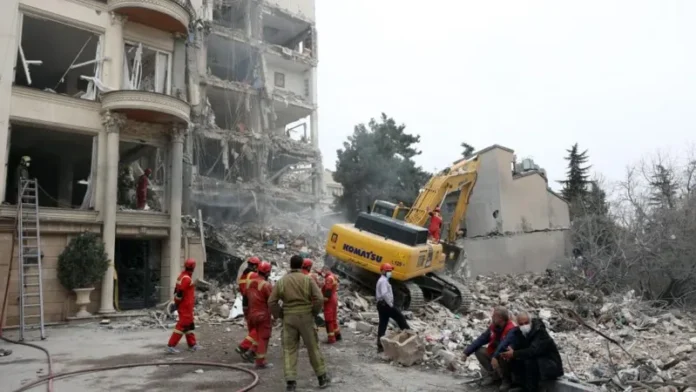


United States – Washington, D.C.: Diplomatic uncertainty grows as mixed messages from Tehran and Washington deepen confusion over potential negotiations and ongoing regional conflict tensions
The United States has temporarily paused a high-stakes ultimatum directed at Iran, intensifying uncertainty over whether diplomacy or escalation will shape the next phase of the ongoing conflict.
US President Donald Trump had warned Tehran to reopen the strategically vital Strait of Hormuz or face targeted attacks on its power infrastructure. The narrow waterway is a critical global oil route, and its disruption has already triggered a sharp rise in international energy prices.
Just hours before the deadline expired, Trump announced a five-day pause, citing what he described as “major progress” in talks aimed at ending more than three weeks of escalating hostilities between US and Israeli forces and Iran.
However, officials in Tehran quickly contradicted those claims. Iran’s parliament speaker Mohammad Bagher Ghalibaf dismissed reports of negotiations as “fake news,” deepening confusion over whether any meaningful dialogue is actually taking place.
A day later, Trump insisted that Washington was communicating with “the right people” inside Iran, though he offered no specifics. The conflicting narratives have left analysts and citizens alike questioning the true state of diplomacy.
Inside Iran, the situation is further obscured by a government-imposed internet shutdown that has severely restricted communication with the outside world. While some citizens resort to illegal satellite connections such as Starlink to access information, most remain cut off from reliable updates.
State-controlled media has portrayed a unified front, broadcasting images of nightly pro-government gatherings across cities. Supporters of the regime have echoed official skepticism toward negotiations with the United States, reinforcing a narrative of resistance.
Yet beneath this surface, Iranian society appears deeply divided.
For many ordinary citizens, the immediate priority is an end to the violence. Kiana, a young woman living in Tehran, expressed conflicting emotions about the prospect of a ceasefire that might leave the current leadership intact.
“If the war ends, the explosions will stop,” she said. “But we will still be left with a weakened regime that could become even more violent toward its own people.”
Her concerns reflect broader fears of internal repression. Recent protests in Iran were met with a severe crackdown, with thousands reportedly killed, according to human rights groups. The memory of that violence remains fresh in the minds of many Iranians.
Others, like Armin, also from Tehran, share the desire for peace but reject the idea of negotiations altogether.
“Any deal will make the government stronger internationally,” he said. “That will only give them more power to oppress people.”
Armin argued that international efforts should focus instead on supporting internal movements for change rather than engaging with the current leadership.
Meanwhile, some voices within Iran support the continuation of pressure, even if it means prolonged conflict. Parsa, a resident of Karaj, believes the regime must be weakened further before meaningful change can occur.
“They are in a position of weakness,” he said. “If they survive this, they will crack down even harder.”
Such views highlight the complex calculus facing many Iranians, who must weigh the immediate dangers of war against the long-term implications of political stability under the current system.
The situation has also triggered internal displacement, with some residents fleeing major cities like Tehran for relatively safer regions. Sadaf, who relocated to Mazandaran province, described living in constant fear of infrastructure disruptions.
“I want the leadership gone,” she said. “But I’m also worried about losing electricity and water.”
Her concerns underscore the humanitarian dimension of the crisis, as civilians grapple with the potential collapse of essential services.
Caught between these opposing perspectives are those who feel powerless amid decisions made by global powers. Mahtab, another Tehran resident, described a sense of resignation.
“It feels like everything is decided for us,” she said. “We tell ourselves we have control, but we really don’t.”
Her words capture the frustration of many who see their lives shaped by forces beyond their influence, from international diplomacy to military strategy.
The broader geopolitical context adds another layer of complexity. Both Trump and Israeli Prime Minister Benjamin Netanyahu have suggested that their actions could create conditions for internal change in Iran.
So far, however, there is little evidence that such expectations are being realized. Iranian authorities have issued stern warnings against public protests, with security forces prepared to respond forcefully to any perceived dissent.
Police chief Ahmadreza Radan has publicly stated that individuals taking to the streets at what he described as the “enemy’s request” would be treated as adversaries.
These measures have effectively suppressed visible opposition, limiting the potential for large-scale uprisings despite underlying dissatisfaction.
As the five-day pause in the US ultimatum continues, the path forward remains uncertain. The absence of clear communication between Washington and Tehran, combined with internal divisions within Iran, complicates efforts to predict the outcome.
Energy markets, meanwhile, remain volatile, reflecting the global stakes tied to the Strait of Hormuz. Any prolonged disruption could have far-reaching economic consequences beyond the immediate region.
For now, the pause offers a brief window for diplomacy. Whether it leads to a meaningful breakthrough or merely delays further escalation will depend on decisions made in the coming days.
For millions of Iranians caught in the middle, the hope is for an end to both external conflict and internal repression—though achieving both simultaneously remains an elusive goal.
This article was created using automation technology and was thoroughly edited and fact-checked by one of our editorial staff members